1962 Elkhart Tenor Sax
by Paul D. Race
 My first saxophone came from a mail-order catalog. Actually saxophone wasn't my first choice. I loved the sound of a French horn from an early age. When the music store people came to the school auditorium in 1962 to demonstrate band instruments and take orders, I went expecting to come home with a French horn. But while I was drooling over the French horn, my father (who had pegged me as a slacker by my fourth birthday) was asking the sales guy which instrument was easiest to learn. Somewhere over my head, literally as well as figuratively, the guy answered, "Saxophone, definitely." "What about French horn?" "Nobody starts on that; it's too hard to play." "What do people who want to play French horn start on?" "Trumpet." "Is that easier than French horn?" "Yes, much." "Is it easier than saxophone?" "No." My first saxophone came from a mail-order catalog. Actually saxophone wasn't my first choice. I loved the sound of a French horn from an early age. When the music store people came to the school auditorium in 1962 to demonstrate band instruments and take orders, I went expecting to come home with a French horn. But while I was drooling over the French horn, my father (who had pegged me as a slacker by my fourth birthday) was asking the sales guy which instrument was easiest to learn. Somewhere over my head, literally as well as figuratively, the guy answered, "Saxophone, definitely." "What about French horn?" "Nobody starts on that; it's too hard to play." "What do people who want to play French horn start on?" "Trumpet." "Is that easier than French horn?" "Yes, much." "Is it easier than saxophone?" "No."
Today I know that a saxophone has always cost at least twice as much as a trumpet. Price-wise it's a "second-tier instrument," along with French horn, baritone horn, and a few others. The first-tier instruments, flute, clarinet, trumpet, cornet, and trombone, all cost about the same (although trombone is sometimes a little cheaper). That way, kids can choose from any of the "core" wind instrument groups without having to decide whether preferring, say, flute over clarinet, is worth spending another $50. (Drum kits are usually a little cheaper, but other factors often steer families away from drums.)
Back in 1962, when I was ten years old, my father - who had very little confidence that I would stick with any instrument - was nevertheless willing to spend more money if it meant improving my chances.
At the time, Dad's favorite sax players were almost all tenor players. I don't know if he imagined that I would one day be a great jazz saxophone player - if he was, I know I disappointed him. But after all, there weren't really many places to learn jazz in Donnelsville, Ohio in 1962. Or - after we moved - Miamisburg, Ohio, in 1964.
"What about tenor?" he asked the sales guy.
"Well, the kids who are really serious usually start with alto and stick with it, because that's the 'main' instrument of the family. Hardly anyone starts on tenor."
Dad looked at the tenor and blanched at the price tag. But he asked, "So, he wouldn't be fighting for first chair or such?"
"Not likely."
Then we went home, and Dad ordered a tenor saxophone through a mail order catalog, probably getting it for 2/3 of what the store model cost. The horn - an Elkhart - probably came from General Merchandise, Dad's mail order catalog of  choice, though it may have come from Sears or Pennys. choice, though it may have come from Sears or Pennys.
A fellow on Flickr has posed several photos of the same model I started on (I think). Click here for a look at his pictures.
Getting a Late Start
The first "problem" with my saxophone was that it arrived two weeks after "band class" had started. So for two weeks, I had been promising my teachers that a horn really was on its way, and sitting through "band class" holding only my music book, while Mr. Allan was showing the other kids how to blow their horns. By the time my horn arrived, even my parents realized that I would need some sort of "jump start" to catch up with the class.
One of my aunt Shirley's inlaws was a woodwind teacher. So when the saxophone came, Dad called "Hap" Ashenfelter and asked if he could help me get started. The first night, Hap looked over the horn, showed me how to put it together, showed me where to put my fingers, and taught me to blow a few notes.
At the next band class, it was clear that I was still behind. When time came for my next lesson (we thought), Dad drove me over, only to find out that Hap hadn't put me on his schedule - he thought my lesson was a one-shot deal and couldn't fit in any new students. Still, he squoze me in one more time. By the time I finished that second and last "lesson," I knew what I needed to catch up with the class, and I was never behind again.
In retrospect, taking lessons from Hap would have been a huge help later on in my life as a would-be saxophone major. But since I was "hanging in there" without lessons, it never seemed critical to me or to my often cash-strapped parents.
Size Does Matter
Another "problem" with my saxophone, when I started out, at least, was that it was nearly as big as I was. The case was huge. While I lived in Donnelsville, we walked to school. I would lug the thing up the hill on band days, then lug it home, the handle on the end of the case announcing my approach by banging with each step. In nice weather, I might take it home at lunch. Back in 1962, no one thought anything of the kids who lived in the neighborhood walking home for lunch.
Later, when we lived in Miamisburg and I took the bus, the sax case took up as much room as another kid - not a good thing when there weren't enough seats anyway. Usually the bus driver made me leave it on by the door where there was a little floor space, with the result that everyone coming in or leaving tripped over it. In the band room, I couldn't put it in the "cubbies" with the rest of the horns - I had to heft it up on the top of the cabinets, where they stored the tubas and other huge instruments. I was very small until I was a junior in high school, so that was interesting too. All of this isn't to say that I wish I had taken up clarinet instead - only to point out that when I was 50" inches tall and weighed 45 pounds, alto sax might have been a better choice. (Tenor had its advantages, though, as I report later.)
What Kind of Horn is an "Elkhart," Anyway?
In my youthful ignorance, there was one more "problem" with my horn - it was an "off brand," to me at least. All my friends has instruments from "real companies" like Selmer or Conn. But I was "stuck" with an "Elkhart" that had come from a mail-order discount store. Although all of the major band instrument companies were headquarted in Elkhart, Indiana, at the time, nobody had ever heard of Elkhart instruments, not "Hap," and not any band director I ever had. Still, I didn't let having an "off-brand" instrument keep me from catching up with the rest of the kids.
Practice, Practice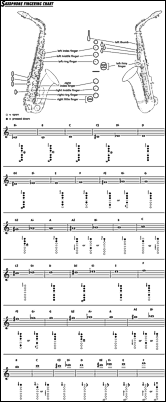
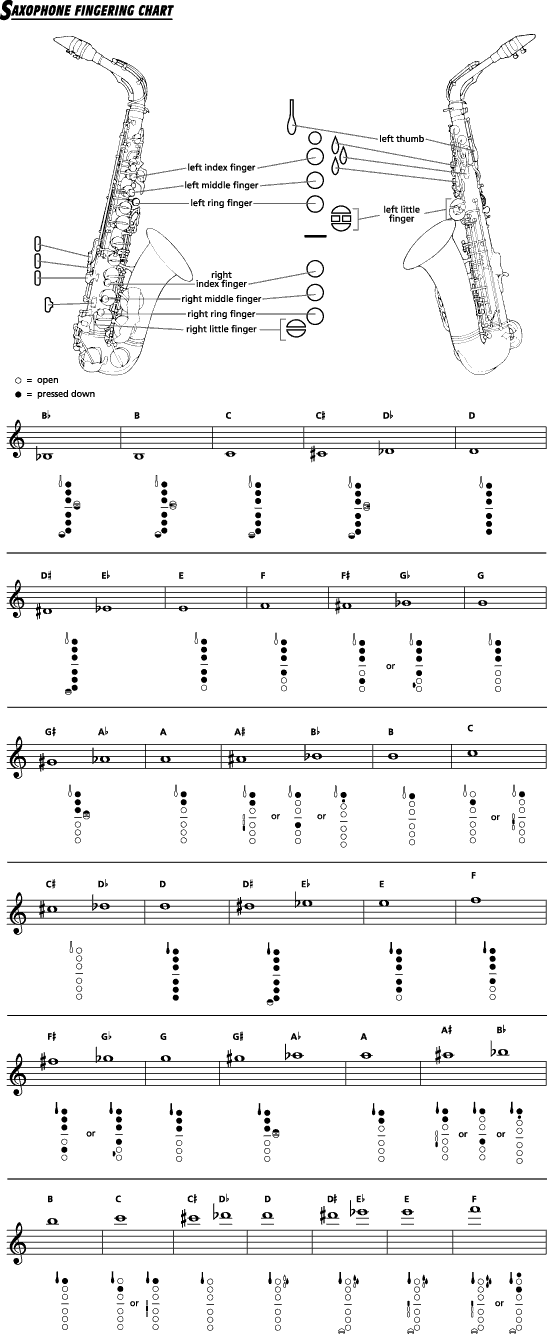
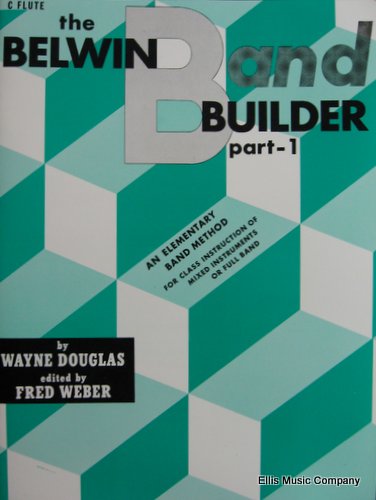
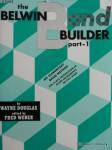 My progress was probably aided by the fact that mom would never check off the practice chart in my Belwin Band Builder booklets unless I had actually practiced. But playing the same beginning exercises over and over and over got old fast. So I went ahead, using the fingering chart in the front to learn the notes we hadn't been taught yet. And I reached the end of the book in a few months. My progress was probably aided by the fact that mom would never check off the practice chart in my Belwin Band Builder booklets unless I had actually practiced. But playing the same beginning exercises over and over and over got old fast. So I went ahead, using the fingering chart in the front to learn the notes we hadn't been taught yet. And I reached the end of the book in a few months.
To give me something else to play, Dad bought a big saxophone practice book with about three hundred songs in it. Some were easy, some were not so easy, but over the next few years, I learned them all. Here's a funny aside - many were 60-100-year old popular tunes like "Old Oaken Bucket," "Aura Lee," "Long, Long, Ago," "My Grandfather's Clock," and "Man on the Flying Trapeze." Somewhere we had also picked up an old "sing-a-long" songbook that had all of those songs, so after I learned the tunes from my saxophone book I learned the lyrics from the songbook. Consequently, as a child I learned dozens of songs that my grandparents would have known by heart, and nobody in my generation - or since - ever heard of. Of course people today are never impressed by the fact that you occasionally recognize tunes they've never heard of. (Trivia Question 1: Oklahoma opens with the first seven notes of what old tune mentioned above? - They play those seven notes twice, in two different keys, in case you didn't catch the reference the first time. Question 2: Which song mentioned above was recorded by Elvis with other words?)
Never Use Brass Polish on a New Brass Instrument
Besides getting no respect, the Elkhart had the bad luck to fall into the hands of a family that had never owned a wind instrument before. So when Mr. Allan told the class that we needed to "polish" the instrument before band concerts, my Mom took his direction seriously. The horn was made of brass, so you should use brass polish, right? Only if you want to take all the lacquer off the horn in a matter of minutes. So by the time the poor thing was thee years old, it looked thirty. Not to mention the wear and tear that any kid puts on an instrument that is nearly as large as he is when he starts out.
Between my sixth and seventh grade, the family moved to Miamisburg, OH, and I wound up in Miamisburg Junior High's band, not a bad place to be, really. Director Tom Coffman loved music, liked most of the kids, and nagged if we hadn't practiced.
The Elkhart tenor then survived two years of junior high and two and a half years of high school. By then, I had discovered guitar. And I has also - unfortunately - learned that I didn't really need to practice saxophone outside of band class to keep up with 99% of the people in the room (I credit my earlier practice for that, not necessarily any inherent talent.) So I practiced irregularly, to say the least. Now I realized that, had I been taking lessons, there were lots of things a teacher would have worked on, intonation and expression being at the top. But I constantly tested out second-chair out of five or six saxophones, beating out a couple kids who were taking lessons, so I didn't worry about continuous improvement like I should have.
I have to admit that my H.S. band director never took me seriously my freshman or sophomore year. Maybe it was the beat-up-looking Elkhart, or maybe it really was my playing. In fact he made me go onto bass clarinet one year - a fate usually reserved for kids who weren't cutting it on clarinet, and that was saying something.
The Final Blow
In the middle of marching band season my Junior year, a kid slammed the band room door on me as I was coming through, snapping my saxophone's neck piece off at the joint. A number of my friends were getting upgrade horns for one reason or another about the same time, but money always seemed tight, and I didn't really expect my folks to chip in for an upgrade. If they had taken my Elkhart to a stand-alone repair shop instead of the big music store in town, it might have gotten a soldering job and a few new pads and lasted me through the rest of high school.
In the music store, though, my parents heard the sales guy explain that the Elkhart was a cheap, off-brand starter instrument and, if they really loved me, they would realize that I deserved a better horn. Frankly, I probably didn't. I was focusing on guitar then, and all but neglecting saxophone. Plus, getting a "decent" horn in the middle of marching band season wasn't really optimum (today I recommend that students looking to upgrade their instruments keep their old horns for marching band).
Revisiting Assumptions
Many years later, while I was researching used saxophones, I came across the Elkhart brand again. Turns out, that Elkhart was more-or-less the student line of Buescher, whose "name-brand" saxophones were in high demand as intermediate instruments, and were often played by working pros. In retrospect, the Elkhart probably compared favorably with the "brand name" starter horns the rest of the class was playing. 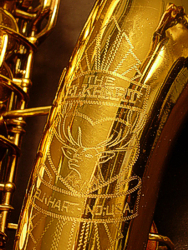
 A term that comes up sometimes is "stencil." Most of the major band instrument companies would make instruments with any brand name on them that you wanted, if you ordered in quantity (piano maker Cable used to do the same thing). So if you had a big music store in NYC or some place and wanted to sell your "own brand" of horn, Martin, Selmer, or Conn would gladly accomodate you. During the peak of saxophone popularity in the 1920s, this was especially common. "Stencil" horns often lacked features of the name-brand versions, but their overall construction is usually close enough to the name-brand version that experts can tell which factory they were built in. A term that comes up sometimes is "stencil." Most of the major band instrument companies would make instruments with any brand name on them that you wanted, if you ordered in quantity (piano maker Cable used to do the same thing). So if you had a big music store in NYC or some place and wanted to sell your "own brand" of horn, Martin, Selmer, or Conn would gladly accomodate you. During the peak of saxophone popularity in the 1920s, this was especially common. "Stencil" horns often lacked features of the name-brand versions, but their overall construction is usually close enough to the name-brand version that experts can tell which factory they were built in.
A few companies made "stencils" just to have a "discount brand" for mail order catalogs and the like. That kept the production lines busy and discouraged would-be competitors from trying to sneak in at a lower price point.
For this market, Conn made Pan-American horns and Martin made Indiana horns. At the worst, the Elkhart was a "stencil," at the best it was a "student-line" horn. Either way it was fairly comparable to the Selmer Bundies and Conn Directors of its day. Like them, it was built to play reasonably well for beginning students. Like them, it was not built to last long.
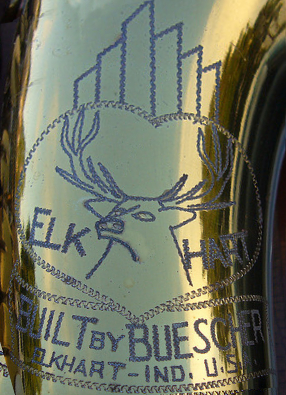
If you think you may have come across one of these, one distinctive feature of these was that the low B and Bb pads were on the left side of the bell, which allowed more room on the right side for the engraving. Mine had a stylized elk-head completely contained in a heart outline. On others, the elk's antlers protuded past the heart outline. Some versions have the Buescher name under the logo and some don't. I think mine looked like the one on the left. The point is that it was a better horn than I or any of my teachers or directors gave it credit for.
Not the Best for Beginners Today
All of this is not to say that an Elkhart would compete with name-brand student horns today. For one point, both Conn and Selmer have substantially improved the ergonomics of their starter instruments. 
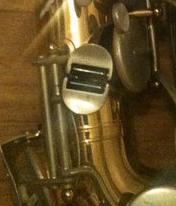
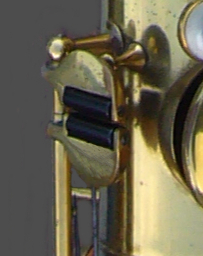
 As an example, compare the photos to the right. These are the Eb and low C keys, operated by the right hand pinky. On the old Elkhart, the keys are flat, requiring 100% vertical pressure to operate them. On the Bundy II, the keys are curved, and they are tilted upward, so the pinky uses a more lateral, more natural motion to play them. The left hand pinky keys are similarly tweaked, as are the palm keys and many others. As an example, compare the photos to the right. These are the Eb and low C keys, operated by the right hand pinky. On the old Elkhart, the keys are flat, requiring 100% vertical pressure to operate them. On the Bundy II, the keys are curved, and they are tilted upward, so the pinky uses a more lateral, more natural motion to play them. The left hand pinky keys are similarly tweaked, as are the palm keys and many others.
Ironically, most of these improvements were first incorporated on "pro horns," to give working musicians an edge. But they've worked their way "downstream" because they also make the horns easier for beginners to play. That's one reason to consider newer horns for beginners and small hands. Of course, if you're, say, an adult alto player looking to pick up an old tenor to double on, you won't have much, if any, trouble making the adjustment between modern an traditional key shapes.
What the Elkhart Taught Me
Fifty years after my first tenor saxophone arrived in the mail, I am convinced that I learned more about music in general playing tenor than I would have on alto anyway. And I've been able to play the thing in a lot more circumstances than I would have a French horn (or even an Alto).
Nobody but tenor sax and baritone horn players know this, but never playing the melody is actually a good education in how all the parts of a piece go together. On marches we always get the countermelody. On pastorales, we always get the cello part, on boogie-woogie, we always get the bass line, and so on. To this day, no matter what the music style, when I'm playing sax improvisationally in an ensemble, the last part that I imagine playing is the melody. And, frankly, that gives me more flexibility and creativity than a lot of people who are more talented in every other way.
Not Missing French Horn as Much as I Thought I Would
As an aside, I also play alto, and have occasionally played it in civic or church bands or whatever. Sadly, in almost every piece that was originally arranged for an orchestra, the so-called Alto Sax part is really just the "F" French horn part transposed to Eb. So, decades after being disappointed that I didn't get to start out on French horn, I learned that, cool as they sound, French horns very seldom get interesting parts. If you play French horn, don't blame me for writing the previous sentence - demand better parts! Or switch to tenor sax.
So, thanks to the old Elkhart. I hope it got fixed and reused by someone else - it really was a decent enough horn, much better than any of the "off-brand" "student instruments" coming out of the Far East today.
If you have or had a late-fifties or early-sixties Elkhart sax and want to add anything or tell your own story, please get in touch - I'll be very glad to hear from you.
Paul Race
www.SchoolOfTheRock.com
www.CreekDontRise.com
All material, illustrations, and content of this web site are copyrighted © 2011-2012 by Paul D. Race. All rights reserved.
School Of The Rock(tm) is a participant in the Amazon Services LLC Associates Program, an affiliate advertising program designed to provide a means for sites to earn advertising fees by advertising and linking to amazon.com.
For questions, comments, suggestions, trouble reports, etc. about this web page or its content, please contact us.
|